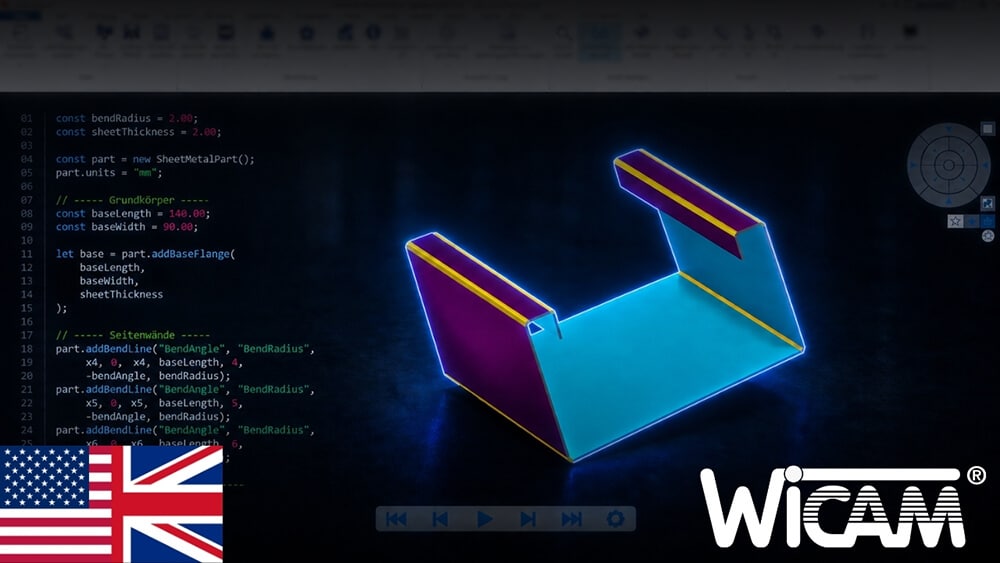
With the latest version of PNBend, WiCAM is expanding its bending programming capabilities with new functions designed to enhance process reliability and enable more flexible component production. The focus is on the automatic detection of critical contours within the bending zone, the programming of parametric 3D variants, and improved support for step bending.
You are currently viewing a placeholder content from YouTube. To access the actual content, click the button below. Please note that doing so will share data with third-party providers.
The new functions help users to identify potential problems as early as the programming stage and to prepare different component variants more efficiently for production.
When creating a bending simulation, PNBend now takes into account contours located within or in the immediate vicinity of a bending zone.
Holes, cut-outs and other contours in the immediate vicinity of a bend can be critical during forming. Thanks to this additional detection feature, these areas are already visible in the simulation and can be assessed accordingly by the programmer.
This function helps to identify potential problems at an earlier stage, thereby reducing the risk of defective components and unnecessary corrections on the machine.
Variant programming has been extended to include the processing of 3D components. This means that parametric components can no longer be generated solely on the basis of traditional 2D geometries, but can be modelled directly in the three-dimensional model.
Particularly for component families that differ only in terms of specific dimensions or versions, 3D variant programming significantly reduces the design workload.
Instead of recreating each component individually, a defined base variant can be used and adapted to the respective order via the relevant parameters.
This makes variant production within PN4000 even more flexible and allows for better integration into automated production processes.
The existing step bending function has been further optimised in the new version of PNBend. This now allows components to be programmed and simulated which could not be modelled, or only to a limited extent, in previous versions.
This applies in particular to parts that consist almost exclusively of a continuous curve and do not have a traditional bend edge. Such geometries can now be better recognised, processed and produced via several individual bending steps.

PNBend is manufacturer-independent and enables the programming of press brakes from all leading manufacturers, making it possible to use our bending simulation for mixed machine fleets. Request your personal online demo now!
WiCAM GmbH
Technische Software
Reetzstraße 46c
76327 Pfinztal-Söllingen
Germany
Phone: +49 7240 9259-0
E-Mail: info@wicam.com
You need to load content from reCAPTCHA to submit the form. Please note that doing so will share data with third-party providers.
More InformationYou are currently viewing a placeholder content from Turnstile. To access the actual content, click the button below. Please note that doing so will share data with third-party providers.
More InformationYou are currently viewing a placeholder content from Facebook. To access the actual content, click the button below. Please note that doing so will share data with third-party providers.
More InformationYou are currently viewing a placeholder content from Instagram. To access the actual content, click the button below. Please note that doing so will share data with third-party providers.
More InformationYou need to load content from hCaptcha to submit the form. Please note that doing so will share data with third-party providers.
More InformationYou need to load content from reCAPTCHA to submit the form. Please note that doing so will share data with third-party providers.
More InformationYou are currently viewing a placeholder content from Turnstile. To access the actual content, click the button below. Please note that doing so will share data with third-party providers.
More InformationYou are currently viewing a placeholder content from X. To access the actual content, click the button below. Please note that doing so will share data with third-party providers.
More Information